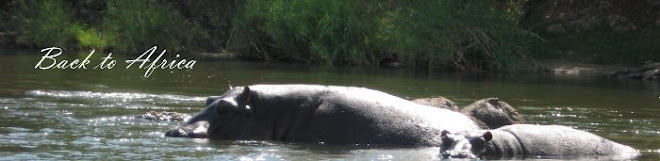
"The contents of this web site are mine personally and do not reflect any position of the U.S. Government or the Peace Corps".

Friday, April 8, 2011

Big drum

I just returned to the village after a few
days in the capital.
As mentioned in the prior blog post, the
cultural group received their first drum
out of two that was requisitioned.
The man standing behind the drum is about
5 ft 8 inches or 1.727 meters tall. That should
give a rough idea as to how tall the drum is.
This evening the Cultural Group broke it out
for the first time.
It was a energized moment. The dancers
danced spiritedly in honor of their new drum.
This drum has a real heavy big drum sound
to it and there is no doubt from anyone hearing
it, that it is substantial.
The drum head is made of goat skin and being
that it is new, is still a little damp and will
tighten up more in time. Despite that it has a
good sound.
The man who made the drum at first was skeptical
that we would pay for it. He mentioned that he'd
made drums before for people whom didn't pay.
He was one happy man when he received his
money immediately upon completion. He then
went back to finish the second one and said that
by Monday it should be completed.
The man worked hard and had to travel out deep
in the bush to find the tree suitable for the drum.
He went into a somewhat dangerous area where
there are buffalo, elephants, hyenas. If there are
buffalo, then probably a few big cats and of course
snakes, just to make this drum. He did a great
job and again, it sounds strong.
An idea for next Saturday night is to bring both
new drums out to the cultural area, light a fire
and have the group perform for the village. Just
like it was in the 'old days'.
I hope we can organize it and make it happen, it
would be great to be able to step back in time
for one night.

Tuesday, April 5, 2011

Footing in Rundu

Even though English is spoken in many countries
there are differences.
The header is an example of that. In the States the
header would be ... Walking in Rundu. But here, if
I said the word walking, not too many people would
understand what I was trying to say. Time and time
again I keep forgetting and use the word walking and
have to consciously make a note to remember to
use 'footing' the next time.
I took the picture while footing to the food store
and the land on the other side of the river is
the neighboring Angola.
At the moment I am in the Capital and hopefully
by Friday it is back in the village. I've received
a message that the drum we had a man make
who lives two villages over, is finished.
It will be the property of the Young San Cultural
Group and it should be the first of two. We are
having a little trouble finding a goat skin for the
second drum and when I get back I hope that
we can get on that.
So for now, it is goodbye from Windhoek.

Wednesday, March 30, 2011

West side influence

The name of this blog 'Back to Africa' is
based on my returning to another country
on the continent. First I spent almost 3 years
in Senegal West Africa, then arrived here
in Namibia two years ago.
This blog entry will be mostly describing the
kola nut that we had available in West Africa.
The reason is that a few months ago, another
volunteer I met took a trip to Mali to visit a
friend. I asked him if he could bring back a few
kola nuts and as you can see in the picture
above, he did.
It sure brought a trip down memory lane and
I added some stats on the kola nut ...

Kola nuts, are native to West Africa. In the 1800s,
a pharmacist in Georgia took extracts of kola, sugar
and coca and mixed them with carbonated water.
His accountant tasted it and called it "Coca Cola."
Today, Coca-Cola still uses kola in its original recipe.
The original Coca-Cola contained coca leaf extracts
(a source of cocaine prohibited in soft drinks in the
U.S. after 1904.)

Kola nuts form an integrated part of the social life; the
nuts are valued for its stimulating, aphrodisiac and
healing qualities.

The nut's aroma is sweet and rose-like. The first taste
is bitter, but sweetens upon chewing. The nut can be
boiled to extract the cola. Cola nut is a breath sweetener
and contains three times (kola has 2–3.5% caffeine)
the caffeine of coffee.

The use of the kola nut, appears to have ancient origins.
It is chewed in many West African cultures, individually
or in a social setting, to restore vitality and ease hunger
pangs. Kola nuts are an important part of the traditional
spiritual practice of culture and religion in West Africa.
Kola nuts are used as a religious object and sacred
offering during prayers, ancestor veneration, and
significant life events, such as naming ceremonies,
weddings, and funerals.

In Senegal the kola nut was definitely used in social
events like meeting a village chief, a gift for someone's
future in-laws at holiday times, baptisms and just
about everything else.

One other custom was for someone who traveled or
spent time away from the village, they had to bring
some presents back to the family. Of course the village
tried to take advantage of it and everyone asked for a
gift.

So, what I used to do was buy a kilo of kola nuts and
a bag of candy for the kids and for about $7 USD
I was able to take care of the whole village of 300
people with as far as gifts were concerned. Also,
they were pretty happy with the kolas as the ones
that were daily users of the kola, didn't have to
deal with a caffeine withdrawal that usually resulted
with them having splitting headaches.

So having these kola nuts here in Namibia was a
fun thing. Didn't need to drink any coffee and like
mentioned above, a small trip down memory lane
went along with the goods.

No one here has ever seen any so I was able to
do a bit of cultural exchange as well.

But got to say after getting a little caffeine buzz
that it'd be nice to have some of these kolas around.

Saturday, March 26, 2011

Always something new ...

to learn. After being in the village
for almost two years it would seem
that there wouldn't be a lot of things
that I haven't seen.

But as I learned last weekend that just
is not be the case.

In this San (Khwe) culture there has been a huge
transition from the hunter/gatherer lifestyle
to the 'newer' way of life. What has happened
is that a lot of the bush knowledge is being
left aside. The younger generation haven't
the skills that their parents and forefathers
have.

It is the way it is now and for that reason I enjoy
collaborating and supporting the Cultural Groups
as they try to keep in touch with the Old Ways.

An example can seen in the picture above. What
you see are two of the young girls in the Cultural
Group learning the process of making rope.
The girl in the foreground is the assistant leader of
the group.

In this case they harvested what looks like a normal
cactus/succulent plant that is just everywhere out
here in the bush.

The process of rope making begins by placing a
stick on the ground then with another slightly
modified stick, strip off the pulpy/skin of the plant.
This is a little bit of work and what is done is
a foot is also used to add pressure during what
can be best described as the scraping process.
The result after scraping off the pulpy part are
fibers that are then divided up to be rolled
by hand into rope.

What was done was two groups of fibers of
approximately 20 each were placed on the thigh.
With one hand holding an end of each group,
the other was used to roll the groups.

One group of fibers were as result rolled in and
incorporated into the other in an easy and efficient
manner.

The finished product was one strong rope and it
had many uses and what was especially interesting
was how it was used to make a trap. I hope to
be able to get a picture of that in the future so I
can add to the blog.

It is one of the hunting methods that the San people
have used over the millennium.

For me, it was something new and reminded me that
I really have a lot more to learn about the 'Old Ways'
of the San people.

Saturday, March 19, 2011

Early morning excitement

Saturday mornings are usually kind of slow.
There isn't any school so there aren't learners
moving about. At this time of the year the
people are still out in the fields so the
central part of the village resembles a
ghost town on the weekends.
This morning I happened to step out and
go the one of the village's little shops
called (kuka shop). Just needed to get a
few things and it was a glorious morning,
sun out, no clouds and just the right
temperature.
As I was walking back home all of a sudden
came this drone of what I thought was an
airplane. Lo and behold coming in from the
east was what you see in the picture above.
Our village is an old military base converted
to a settlement/village. So we have this really
official sized landing strip that still survives
in good condition approximately 35 to 40
years after it was put down.
I was told that several years ago that the Klitscho
brothers (boxing champions) actually landed
here as part of a promotion they made for
some organization.
But today it wasn't any boxing champions, just
two German guys that are working doing some
aerial research. They needed to refuel and
was on their way back from the DRC (Democratic
Republic of Congo). Eventually they will go back
to where they originated their journey somewhere
in South Africa.
They were very personable guys and they gave
balloons to the kids that you see in the picture.
It was an unexpected moment of excitement
for the village on a Saturday morning and it
killed and hour of time.
So if you have a landing strip in your backyard
you have to expect people to drop in once
in a while, isn't that safe to say?

Sunday, March 13, 2011

Mid March update

I've been out of the village for about 2 weeks. Been up in the capitol and Okahandja. In the picture is some of the people who participated in a culinary cultural day. It was held at the training center and it is an activity to acclimate the new group of volunteers to the diverse cultural foods of Namibia. And speaking of diversity, the girl on the left is a Ghanain-American and on the right is an Iranian-American. Kind of interesting to be around the peoples of different cultures. Even if they are from one's own country. But now it is riding in a pickup truck back to the north and hopefully with luck, the village.

Tuesday, March 1, 2011

Another view

Right now I am in the Capital (Windhoek) for
a few days then it is off to spend a week in
Okahandja with the new group of trainees.
They arrived a few weeks ago and during
their training cycle there are experienced
volunteers spending time with them to talk
and pass on what they've learned.
The picture is just a view from the room
that we are staying in.
Windhoek isn't a bad place as far as Capitals
go.
It is actually fairly easy to move around and it isn't
anywhere near as congested as other capitals. This
is due to the fact that Namibia is the second least
populated country in earth. Only Mongolia is less
densely populated.
After living in the bush for most of the two years
that I've been here, coming to the big city and having
access to the amenities is a treat. But, what
comes to mind is that the simplicity of the village
isn't such a bad thing.
But once in a while a little splurging isn't a bad
thing to do.
So for the next two weeks it is food, hot water and
real stores that have more than 10 things in them.
It is a time of plenty.

Wednesday, February 16, 2011

On the Okavango River

In the picture you can see the members of the older
San (Khwe) cultural group from the village. Today
we had what is best described as an outing. For
all but one of the group, it was their first time ever
in a boat.
The village we come from is about 70 kilometers
from here and directly in the bush, no rivers around.
It was a real good experiential day for the group as
we also visited 3 lodges along the river as a fact
finding, motivational and life experience exercise.
The boat was generously provided to us by Nunda
Lodge.
We went out for about an hour an a half and the main
animal attraction for the day was the hippos.We saw
a family of about 7 with what looked like at least 5
babies. Also there were plenty of birds to see too.
We then ended the day at the local fisheries center.
It is an impressive place and is a research, resource
and informational hub for fish farming in our region.
It is well done.
The importance of all this is that the village has barely
radio service, no television and newspapers rarely
surface. There is just no real consistent source of
information for these kids.
So, activities like these are eye openers and hopefully
motivators. The least, the group is a little bit more
intelligent for the information they've received.
Out here without sources of information it is like
building a house one brick at a time. Every bit of
information is a building block for development.

Sunday, February 13, 2011

Update 13 February

Life 70 kilometers out in the bush is moving
along at it's usual pace. The work with the
cultural group continues (picture - group
working on list of songs) and the kids are
not only getting better but also becoming
extremely creative. They've made about 5
more new songs. It brings up a point about
culture. Culture is really an ongoing process.
As the kids have learned old songs they are
also making new ones.
The main part of my work has been in the
direction of behavior change. Working with,
for example, the cultural group, the goal is
to keep the kids engaged and hopefully down
a good path.
It has been almost two years since arriving in
Namibia and in the 3rd week of April it will
be the second year anniversary in the village.
I have asked for and received one more year
in Namibia. So, this time next year I should be
writing about a third year anniversary.
There are quite a few things that can still be
done here in the village. So I decided that I'd
stick around and continue to hopefully help out.
So, there is another year of blogging ahead.

Monday, January 24, 2011

Into the new year

At this posting it is almost exactly one-twelfth
into a new year.
Things are moving along very rapidly and
the holidays went well. With Christmas in the
village and New Year in a town called Rundu,
it was a good mix of styles.
In the village it was with the new site mate
(named Gretchen) and we just cooked, talked
and mingled with the villagers. It is always a
little bit awkward feeling to be in a warm country
at Christmas time. I am from the northeast in
the States so it is usually cold. After the years
we must get a little programmed into how it should
feel at certain times.
In the new year we are continuing forward in
evolving the little projects and activities that we've
begun since I've arrived here. One thing about projects
that I've learned, that is that if sustainability is the goal,
then it takes a length of time to get it solid. It is all
about the management and that's the biggest challenge.
Despite the all the time I've spent in the Peace Corps
and living with different levels of accommodations, there
always seems like there is something new to discover.
In the picture you can see a candle under a pot. With
the village generator broke again and it raining fairly
well (making fire wood wet) and not having a gas stove,
it requires a little imagination to cook.
With that setup we made coffee, cookies and soup.
It is just using the simple principle of putting heat into
a pot. Candle gives off heat, so it seemed possible
and it worked. It is fun to try and figure these things out.
At this time I am in a city called Okahandja getting ready
to head out to our group's COS or close of service
conference. It is almost 2 years already since we arrived
in Namibia. It is always an interesting time. Reflecting back
on the journey is always special. There are always the
good and bads but at this point they are the tools that
have helped us change over our tours.
It will be the last time that we will be together as a group.
People will be leaving at different times over the next
three months, so these next few days are the last
chance to hang around together.
In the end, we were like a team. We came, we did what
we could and we always have the memories. It makes
coming here all worth it.